Nattokinase Supplements for Cardiovascular Product Formulation
Formulate nattokinase supplements with B2B guidance on enzyme activity, processing, QC, COA review, pilot validation, and sourcing.

A practical guide for supplement brands, contract manufacturers, and ingredient buyers evaluating nattokinase enzyme for cardiovascular supplement applications.
What Is Nattokinase for Supplement Manufacturing?
Nattokinase is a fibrinolytic enzyme produced during fermentation of soybeans with Bacillus subtilis var. natto or related production strains. In B2B supplement development, it is used as an active enzyme ingredient in capsules, tablets, stick packs, and combination cardiovascular supplement formulas. Buyers searching “what is nattokinase,” “nattokinase supplement,” or “nattokinase supplements” should distinguish consumer wellness language from industrial specifications. The key commercial measure is activity, commonly reported in fibrinolytic units such as FU/g, rather than simple milligram weight. A high-weight powder with low activity may deliver less functional enzyme per serving than a concentrated, well-standardized material. For sourcing, request the strain background, fermentation substrate information, carrier system, enzyme activity method, allergen position, and suitability for the target market. If the source is soy-derived, labeling and allergen review should be completed early.
Primary buying metric: validated FU activity • Typical formats: capsules, tablets, sachets, blends • Key document set: COA, TDS, SDS, method summary
Formulation Conditions That Protect Enzyme Activity
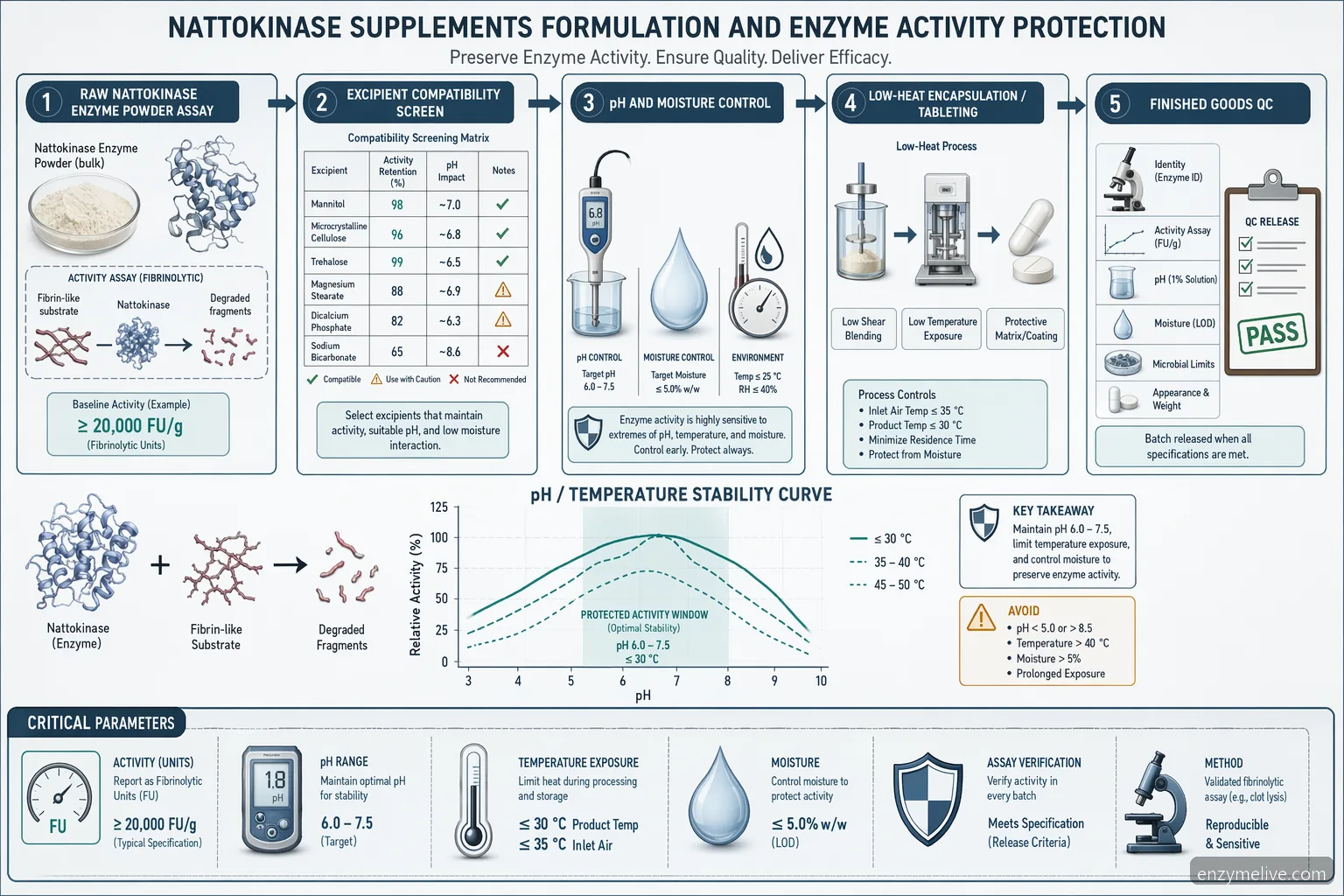
Nattokinase enzyme performance depends on preserving protein structure through manufacturing and shelf life. As a protease, it is generally more compatible with mild, dry processing than with high heat, aggressive solvents, or high-moisture systems. Many commercial materials are best handled near neutral conditions, with formulation exposure commonly kept around pH 6.0–8.5 when wet contact is unavoidable. Avoid prolonged exposure above 40–50°C unless the supplier provides heat-stability data for the exact grade. For dry blends, control relative humidity, minimize open-bin residence time, and qualify excipients for low water activity. Capsules often provide the simplest low-stress format. Tablets require compression studies because high pressure, frictional heat, and acidic or reactive excipients may reduce activity. If enteric systems are used, validate release and retained activity rather than assuming protection.
Keep processing dry and low heat where possible • Validate activity after compression or coating • Avoid unqualified acidic, hygroscopic, or reactive excipients • Confirm compatibility in the final formula, not only in raw material
Dosage Bands, Label Targets, and Cost-in-Use
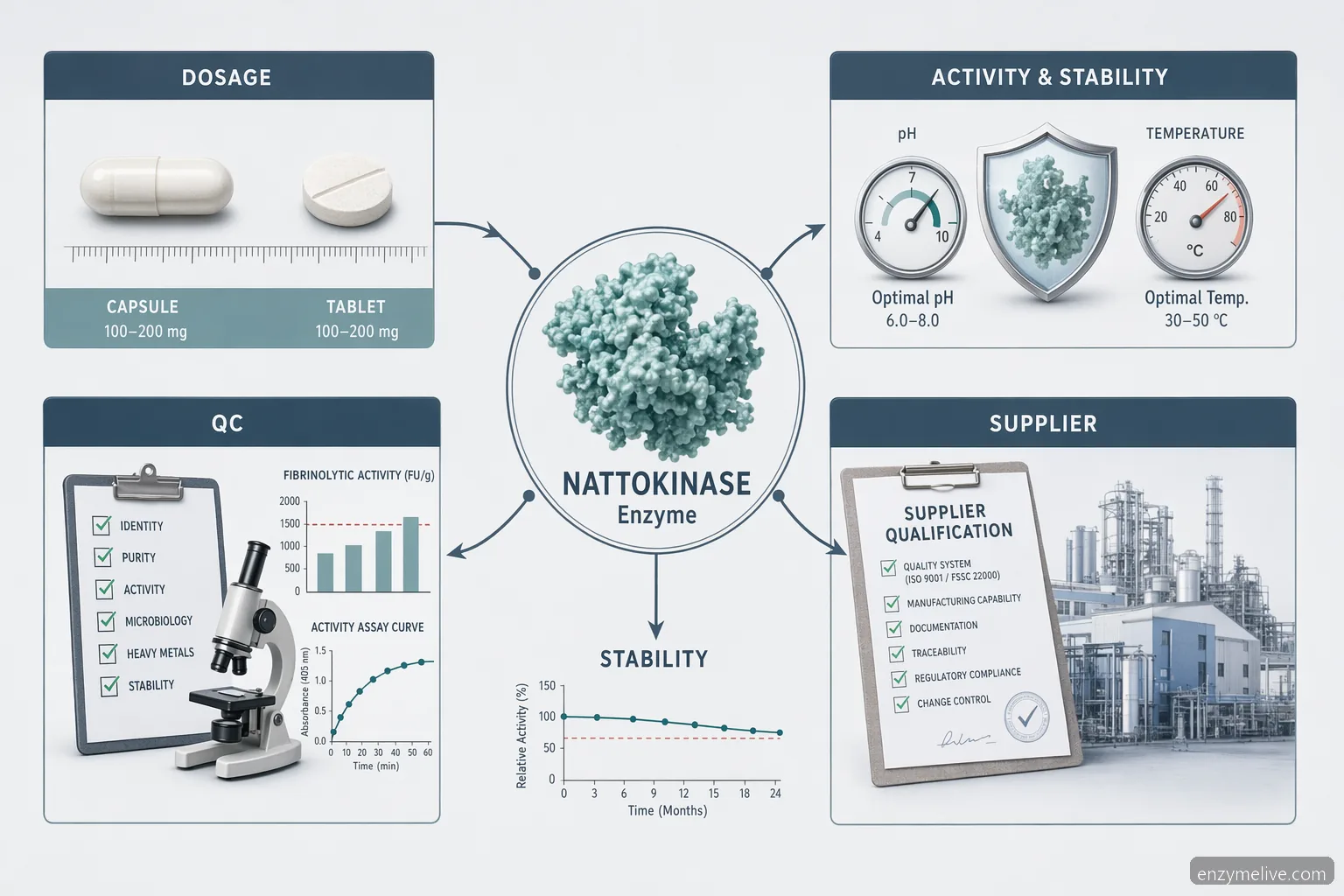
For industrial planning, nattokinase dosage is usually modeled by FU per serving and finished-unit economics. Commercial supplement concepts often evaluate ranges such as 1,000–4,000 FU per serving, but final positioning depends on local regulations, label strategy, customer requirements, and safety review. This article is not medical supplement advice and does not recommend consumer use levels. Instead, buyers should calculate cost-in-use from the supplier’s guaranteed activity, required serving target, manufacturing loss, overage, and minimum order quantity. For example, a higher-activity powder may reduce fill weight, capsule size, and freight cost, while a lower-cost powder may require more overage if activity variation is wide. Ask suppliers whether activity is guaranteed at manufacture only or through shelf life under stated storage conditions. Finished-product claims should be reviewed by regulatory specialists before launch.
Model FU per serving, not only price per kilogram • Include overage for processing and shelf-life loss • Compare capsule size impact and blend loading • Check whether activity is guaranteed through expiry
QC Checks for Raw Material and Finished Goods
A robust nattokinase supplement specification should combine enzyme activity testing with standard food or supplement quality controls. The COA should list batch number, manufacturing date, activity in FU/g, test method reference, moisture or loss on drying, appearance, microbial limits, and contaminant results where applicable. Depending on market and risk assessment, buyers may request heavy metals, pesticide screening, residual solvent data, mycotoxins, and allergen statements. Finished goods should be tested for retained activity after blending, encapsulation or tableting, and accelerated and real-time stability. If the formula includes minerals, botanicals, acids, probiotics, or proteolytic enzymes, conduct compatibility testing because matrix effects can change assay recovery. Retain reference samples and define investigation rules for low-activity results, including retesting, method suitability, and supplier notification.
Raw material: FU/g, identity, moisture, microbes, contaminants • Finished product: FU per serving after processing • Stability: accelerated plus real-time confirmation • Method suitability: verify assay recovery in the final matrix
Supplier Qualification for Nattokinase Kaufen Decisions
Procurement teams evaluating “nattokinase kaufen” should qualify suppliers beyond price and marketing claims. Start with a complete technical package: COA, TDS, SDS, flow chart, allergen statement, country of origin, production site information, shelf-life statement, storage instructions, and specification limits. Ask whether the nattokinase is fermented, purified, spray dried, granulated, or blended with carriers, and whether any anti-caking agents are used. Review change-control practices, batch traceability, lead times, minimum order quantities, and complaint handling. For regulated supplement markets, confirm that documentation aligns with the buyer’s own quality system and applicable local requirements; do not rely on generic claims without evidence. A good supplier can support pilot lots, method clarification, retained samples, and consistent activity across commercial batches.
Request documents before price negotiation • Audit traceability and change-control capability • Confirm carrier, substrate, and allergen details • Use pilot lots before full-scale commitment
Pilot Validation Before Commercial Scale-Up
Pilot validation reduces launch risk for nattokinase supplements by measuring real activity loss during the intended process. Run a small-scale blend using commercial excipients, target mixing time, sieve size, lubrication step, and planned packaging. For capsules, check fill uniformity, segregation, moisture pickup, and retained FU per serving. For tablets, test compression force, hardness, disintegration, friability, and activity after tableting. For powders or stick packs, verify flow, dosing accuracy, flavor system compatibility, and water activity. Packaging studies should compare bottles, blisters, sachets, desiccants, and oxygen or moisture barriers if needed. Build a cost-in-use model from pilot data: raw activity, process loss, overage, rejected units, packaging cost, and stability margin. This evidence-based approach supports supplier selection and avoids relying on nattokinase erfahrungsberichte or anecdotal reports.
Measure FU loss at each processing stage • Test the actual excipient and packaging system • Use pilot data to set overage and specifications • Document results for quality and procurement review
Technical Buying Checklist
Buyer Questions
Nattokinase is a fibrinolytic enzyme ingredient commonly produced by fermentation associated with natto. For supplement manufacturers, the practical focus is not the consumer definition but the technical specification: FU/g activity, batch consistency, carrier system, allergen status, storage conditions, and compatibility with the intended dosage form. Buyers should evaluate it like an active enzyme material, with validated testing and finished-product stability data.
Searches for nattokinase wirkung reflect consumer interest in perceived effects, but B2B teams should separate marketing language from substantiated, compliant positioning. Review the supplier’s technical data, published method references, regulatory status in the target market, and permitted structure or function language. Any finished-product claim should be reviewed by qualified regulatory counsel and should not exceed the evidence and local supplement rules.
From a product-development perspective, nattokinase dangers include unsuitable claims, inadequate warning review, allergen mislabeling, inconsistent enzyme activity, microbial or contaminant failures, and poor stability. Because nattokinase is positioned around circulation-related wellness, brands should conduct a formal safety and label review, including interactions and contraindication language where required. This page does not provide medical advice or consumer dosing recommendations.
Queries such as nattokinase wirkung leber should be handled cautiously. Unless the brand has market-specific substantiation and regulatory approval for liver-related language, avoid implying liver benefits. For B2B formulation, focus instead on measurable quality attributes: enzyme activity, purity, microbial controls, excipient compatibility, and stability. If liver-related consumer questions are expected, prepare compliant customer-service language reviewed by regulatory and scientific teams.
Nattokinase wirkungseintritt is a consumer-facing timing question and should not be used as a manufacturing specification unless supported by appropriate evidence and compliant claims. For manufacturers, the more relevant timing data are dissolution, disintegration, enzyme release, and retained activity after production and stability. If comparing capsules, tablets, or enteric formats, run finished-product testing rather than assuming the same release profile.
Nattokinase erfahrungsberichte, or user experience reports, may reveal market interest but should not guide industrial procurement. Supplier selection should rely on objective evidence: COA consistency, TDS detail, SDS availability, assay method transparency, pilot validation, stability results, traceability, and responsive technical support. Procurement teams should combine quality review with cost-in-use analysis before approving a commercial nattokinase ingredient.
Nattokinase for Research & Industry
Need Nattokinase for your lab or production process?
ISO 9001 certified · Food-grade & research-grade · Ships to 80+ countries
Frequently Asked Questions
What is nattokinase in a B2B supplement context?
Nattokinase is a fibrinolytic enzyme ingredient commonly produced by fermentation associated with natto. For supplement manufacturers, the practical focus is not the consumer definition but the technical specification: FU/g activity, batch consistency, carrier system, allergen status, storage conditions, and compatibility with the intended dosage form. Buyers should evaluate it like an active enzyme material, with validated testing and finished-product stability data.
How should manufacturers evaluate nattokinase wirkung claims?
Searches for nattokinase wirkung reflect consumer interest in perceived effects, but B2B teams should separate marketing language from substantiated, compliant positioning. Review the supplier’s technical data, published method references, regulatory status in the target market, and permitted structure or function language. Any finished-product claim should be reviewed by qualified regulatory counsel and should not exceed the evidence and local supplement rules.
What are the main nattokinase dangers for product developers to assess?
From a product-development perspective, nattokinase dangers include unsuitable claims, inadequate warning review, allergen mislabeling, inconsistent enzyme activity, microbial or contaminant failures, and poor stability. Because nattokinase is positioned around circulation-related wellness, brands should conduct a formal safety and label review, including interactions and contraindication language where required. This page does not provide medical advice or consumer dosing recommendations.
Does nattokinase wirkung leber require special formulation claims?
Queries such as nattokinase wirkung leber should be handled cautiously. Unless the brand has market-specific substantiation and regulatory approval for liver-related language, avoid implying liver benefits. For B2B formulation, focus instead on measurable quality attributes: enzyme activity, purity, microbial controls, excipient compatibility, and stability. If liver-related consumer questions are expected, prepare compliant customer-service language reviewed by regulatory and scientific teams.
How fast is nattokinase wirkungseintritt in finished supplements?
Nattokinase wirkungseintritt is a consumer-facing timing question and should not be used as a manufacturing specification unless supported by appropriate evidence and compliant claims. For manufacturers, the more relevant timing data are dissolution, disintegration, enzyme release, and retained activity after production and stability. If comparing capsules, tablets, or enteric formats, run finished-product testing rather than assuming the same release profile.
Are nattokinase erfahrungsberichte useful for supplier selection?
Nattokinase erfahrungsberichte, or user experience reports, may reveal market interest but should not guide industrial procurement. Supplier selection should rely on objective evidence: COA consistency, TDS detail, SDS availability, assay method transparency, pilot validation, stability results, traceability, and responsive technical support. Procurement teams should combine quality review with cost-in-use analysis before approving a commercial nattokinase ingredient.
Related: Best Nattokinase Benefits in Industrial & Supplement Processing
Turn This Guide Into a Supplier Brief Request nattokinase specifications, pilot samples, and cost-in-use support for your cardiovascular supplement project. See our application page for Best Nattokinase Benefits in Industrial & Supplement Processing at /applications/nattokinase-industrial-benefits/ for specs, MOQ, and a free 50 g sample.
Contact Us to Contribute