How to Use Nattokinase Powder in Cardiovascular Supplement Formulations
Formulate nattokinase powder supplements with activity units, process limits, QC tests, pilot validation, and supplier qualification guidance.
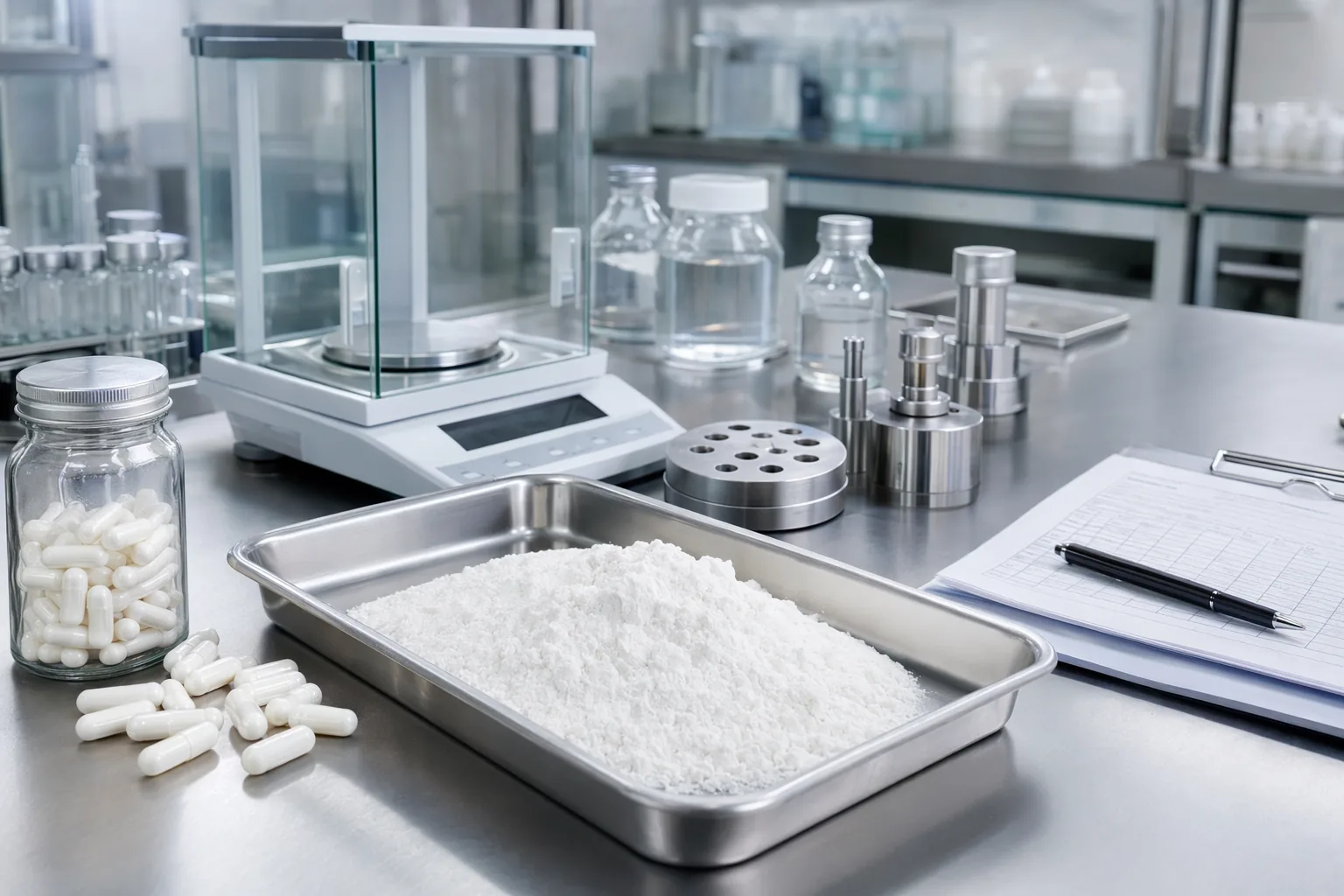
A practical B2B guide for R&D, sourcing, and contract manufacturing teams evaluating nattokinase powder for capsules, tablets, sachets, and blended cardiovascular supplement formats.
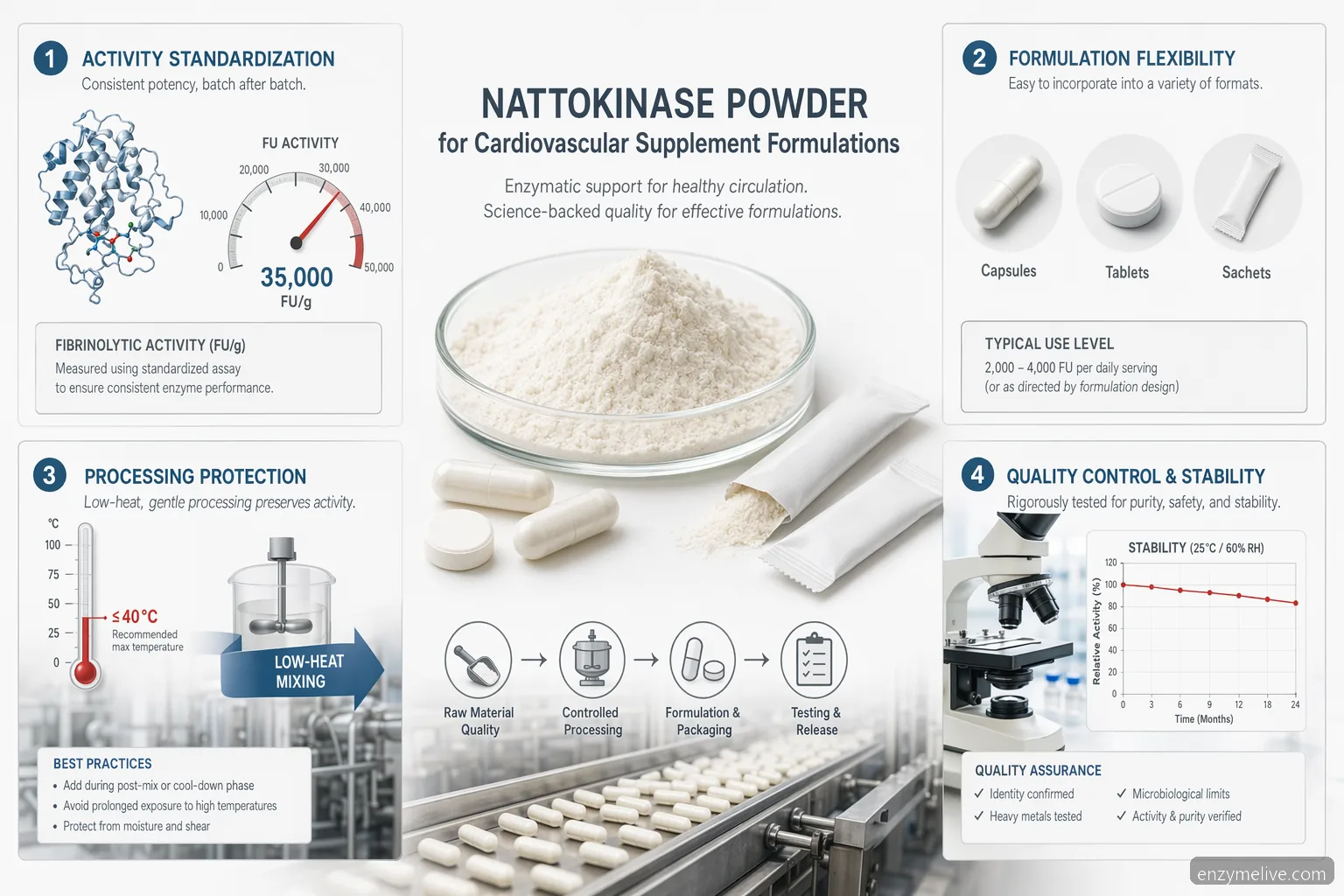
Formulation Role of Nattokinase Powder
Nattokinase powder is a fermented enzyme ingredient used by supplement manufacturers in cardiovascular supplement concepts, blood circulation positioning, and fibrinolytic enzyme blends. It is commonly described as a serine protease produced through controlled Bacillus subtilis fermentation, then purified, dried, and standardized to activity. For B2B formulation work, the key question is not simply what is nattokinase, but whether the selected grade delivers consistent enzyme activity after blending, encapsulation, tableting, packaging, and shelf life. Buyer specifications should separate marketing language such as nattokinase wirkung from measurable industrial requirements, including activity units, loss on drying, particle size, microbial limits, contaminants, and traceability. Because regulatory categories and permitted claims vary by market, R&D teams should treat nattokinase as a functional supplement ingredient and avoid unsupported disease or treatment claims in finished product materials.
Primary format: hard capsules, tablets, stick packs, and dry blends • Key unit: FU activity per gram or per serving • Main risk: activity loss during processing and storage
Raw Material Specification and Activity Standardization
Nattokinase supplement formulations should be built around enzyme activity rather than simple milligram input. Commercial nattokinase powder may be supplied at different potencies, for example low, medium, or high FU per gram grades, so two powders with identical weight can produce very different label activity. Request the supplier COA for each lot and confirm the assay method used for fibrinolytic activity. The TDS should describe carrier system, appearance, solubility or dispersibility, recommended storage, and processing precautions. The SDS should cover handling, dust control, and occupational exposure considerations. For industrial qualification, also request allergen status, GMO statement where relevant, country of origin, fermentation organism declaration, heavy metals, microbiology, residual solvents if applicable, and absence of undeclared pharmaceutical actives. If the product will be sold through nattokinase kaufen or similar online channels, claims and specifications must remain aligned with local rules.
Specify target FU per capsule, tablet, or sachet • Confirm assay method consistency across lots • Check carrier and excipient contribution to label declarations • Set acceptance ranges before purchase orders are issued
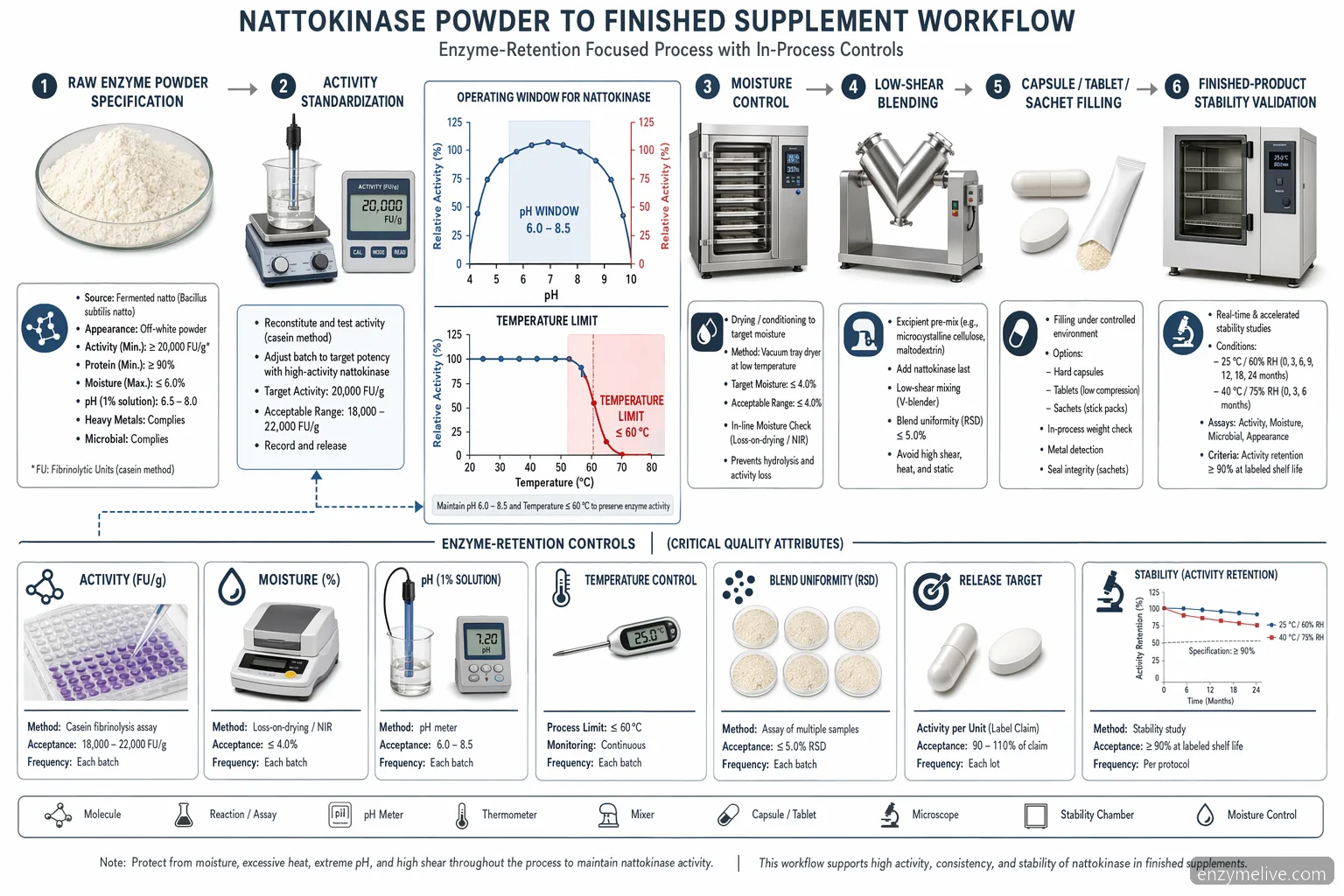
Processing Conditions for Enzyme Retention
Nattokinase is a protein enzyme, so process severity directly affects activity retention. As a conservative starting point, keep powder handling and blending below 35 to 40°C where possible, avoid prolonged exposure above 45°C, and do not use high-temperature drying after the enzyme is added. Dry blending is usually preferred over aqueous granulation because excess water can accelerate degradation and create microbiological risk. Keep blend water activity and loss on drying within the finished product specification, and protect the material from humid air during dispensing and compression. Nattokinase activity is generally more compatible with near-neutral to mildly alkaline conditions than with strong acid exposure, so formulation teams often evaluate enteric systems or delayed-release formats where justified by product positioning. For tablets, validate compression force because excessive pressure can reduce activity even when appearance and hardness look acceptable.
Preferred processing: low-shear dry blending and encapsulation • Avoid: heat, high moisture, aggressive solvents, and excessive compression • Typical formulation pH target for compatibility screening: about pH 6.5 to 8.5 • Store bulk powder sealed, cool, dry, and protected from light
Dosage Design, Release Profile, and Label Targets
In B2B development, dosage design starts with the target activity per serving, local regulations, finished format capacity, and stability data. Many finished products in the market are formulated around activity-based bands such as 1,000 to 4,000 FU per daily serving, but this is a formulation benchmark, not medical advice or a universal recommendation. The final input level depends on the supplier potency, overage justified by stability studies, and label claim strategy. For capsules, nattokinase powder can be combined with flow aids and fillers that do not increase moisture or shift pH aggressively. For tablets, activity after compression must be tested, not assumed. Questions such as nattokinase wirkungseintritt should be handled carefully: manufacturers can validate disintegration and dissolution timing in vitro, but should not imply a guaranteed human onset without appropriate substantiation.
Calculate input from FU target, assay potency, and expected process loss • Use in vitro disintegration or dissolution tests for release comparison • Avoid translating release timing into unsupported physiological claims
Quality Control, Stability, and Pilot Validation
A robust nattokinase powder program should include incoming QC, in-process checks, pilot validation, and shelf-life confirmation. Incoming tests typically include appearance, odor, identification, fibrinolytic activity, loss on drying or water activity, mesh or particle size, total plate count, yeast and mold, pathogens, heavy metals, and any region-specific contaminants. During pilot production, sample after blending to confirm uniformity, after encapsulation or compression to confirm activity retention, and after packaging to establish the real label claim. Accelerated and real-time stability should monitor activity loss, moisture uptake, capsule brittleness, tablet hardness, disintegration, and microbial stability. If the formula includes botanicals, minerals, acids, or hygroscopic excipients, run compatibility studies before scale-up. Concerns sometimes searched as nattokinase dangers should be translated into practical product controls: accurate labeling, contaminant limits, contraindication language where legally required, and avoidance of exaggerated claims.
Run pilot batches before commercial launch • Test enzyme activity after each critical process step • Use stability data to justify any activity overage • Keep retains for investigation and trend analysis
Supplier Qualification and Cost-in-Use
Procurement should evaluate nattokinase powder on delivered activity, documentation quality, supply reliability, and formulation performance, not only price per kilogram. A lower-priced enzyme can become expensive if potency is low, overage is high, moisture sensitivity causes rejects, or documentation delays market entry. Supplier qualification should include review of COA consistency across multiple lots, TDS clarity, SDS availability, change-control policy, traceability, audit readiness, packaging integrity, lead time, and technical support. Ask for pilot quantities from the same production route intended for commercial supply. Cost-in-use should calculate FU delivered to the finished unit after processing and stability, plus wastage, testing, freight, duties, and inventory risk. For international search demand around nattokinase supplements, nattokinase kaufen, and nattokinase wirkung leber, align specifications and claims with each target market rather than using one global label assumption.
Compare suppliers by cost per retained FU, not only cost per kg • Require lot-specific COA and current TDS/SDS • Confirm change notification and supply continuity expectations • Document approval criteria in the vendor qualification file
Technical Buying Checklist
Buyer Questions
Nattokinase powder is an enzyme ingredient produced by fermentation and standardized for fibrinolytic activity, usually expressed as FU per gram. In supplement manufacturing, it is used as a functional ingredient for cardiovascular supplement concepts and enzyme blends. Industrial buyers should evaluate it by activity retention, purity, documentation, microbial quality, stability, and regulatory suitability rather than by ingredient weight alone.
Choose the grade by target FU per finished serving, process compatibility, documentation, and cost-in-use. Compare the supplier COA, TDS, SDS, potency range, carrier system, microbiology, heavy metals, allergen status, and stability data. A high-potency grade may reduce fill weight, but it still needs pilot validation for blend uniformity, encapsulation or compression loss, packaging performance, and label claim retention.
Use low-heat, low-moisture processing. As a conservative development approach, keep blending below 35 to 40°C where practical, avoid prolonged exposure above 45°C, and add nattokinase after any high-temperature step. Dry blending and encapsulation are often easier than wet granulation. Validate pH compatibility, moisture uptake, and compression force because enzyme activity can decline even when the finished dosage form looks acceptable.
Yes, but tablets require more validation than capsules. Compression pressure, dwell time, moisture, excipient alkalinity or acidity, and lubricant level can affect enzyme activity and disintegration. Manufacturers should test activity before compression, after compression, and during stability. If the tablet is coated or delayed release, verify that the coating process does not expose nattokinase to damaging heat, solvents, or moisture.
For B2B formulation teams, this topic should be managed through risk controls rather than promotional language. Controls include accurate activity labeling, contaminant testing, microbial limits, compliant warnings where required, supplier traceability, and avoidance of unsupported medical claims. Finished product companies should have regulatory and safety reviews for each market, especially when positioning nattokinase supplements alongside cardiovascular, circulation, or fibrinolytic enzyme language.
Not directly. Manufacturers can measure disintegration, dissolution, and enzyme activity release in vitro, but they should not claim a specific human onset time unless they have appropriate substantiation and regulatory clearance. For formulation design, focus on whether the product releases the intended FU activity under defined test conditions, remains stable through shelf life, and matches the label claim at the end of storage.
Nattokinase for Research & Industry
Need Nattokinase for your lab or production process?
ISO 9001 certified · Food-grade & research-grade · Ships to 80+ countries
Frequently Asked Questions
What is nattokinase powder in supplement manufacturing?
Nattokinase powder is an enzyme ingredient produced by fermentation and standardized for fibrinolytic activity, usually expressed as FU per gram. In supplement manufacturing, it is used as a functional ingredient for cardiovascular supplement concepts and enzyme blends. Industrial buyers should evaluate it by activity retention, purity, documentation, microbial quality, stability, and regulatory suitability rather than by ingredient weight alone.
How should a manufacturer choose a nattokinase enzyme grade?
Choose the grade by target FU per finished serving, process compatibility, documentation, and cost-in-use. Compare the supplier COA, TDS, SDS, potency range, carrier system, microbiology, heavy metals, allergen status, and stability data. A high-potency grade may reduce fill weight, but it still needs pilot validation for blend uniformity, encapsulation or compression loss, packaging performance, and label claim retention.
What processing conditions help protect nattokinase activity?
Use low-heat, low-moisture processing. As a conservative development approach, keep blending below 35 to 40°C where practical, avoid prolonged exposure above 45°C, and add nattokinase after any high-temperature step. Dry blending and encapsulation are often easier than wet granulation. Validate pH compatibility, moisture uptake, and compression force because enzyme activity can decline even when the finished dosage form looks acceptable.
Can nattokinase powder be used in tablets?
Yes, but tablets require more validation than capsules. Compression pressure, dwell time, moisture, excipient alkalinity or acidity, and lubricant level can affect enzyme activity and disintegration. Manufacturers should test activity before compression, after compression, and during stability. If the tablet is coated or delayed release, verify that the coating process does not expose nattokinase to damaging heat, solvents, or moisture.
How should companies address nattokinase dangers in product development?
For B2B formulation teams, this topic should be managed through risk controls rather than promotional language. Controls include accurate activity labeling, contaminant testing, microbial limits, compliant warnings where required, supplier traceability, and avoidance of unsupported medical claims. Finished product companies should have regulatory and safety reviews for each market, especially when positioning nattokinase supplements alongside cardiovascular, circulation, or fibrinolytic enzyme language.
Does nattokinase wirkungseintritt define the dosage form design?
Not directly. Manufacturers can measure disintegration, dissolution, and enzyme activity release in vitro, but they should not claim a specific human onset time unless they have appropriate substantiation and regulatory clearance. For formulation design, focus on whether the product releases the intended FU activity under defined test conditions, remains stable through shelf life, and matches the label claim at the end of storage.
Related: Best Nattokinase Benefits in Industrial & Supplement Processing
Turn This Guide Into a Supplier Brief Request nattokinase powder specifications, samples, and technical support for your next cardiovascular supplement pilot batch. See our application page for Best Nattokinase Benefits in Industrial & Supplement Processing at /applications/nattokinase-industrial-benefits/ for specs, MOQ, and a free 50 g sample.
Contact Us to Contribute