Nattokinase Where To Buy for Cardiovascular Supplement Manufacturing
Compare nattokinase enzyme suppliers for cardiovascular supplements using specs, COA/TDS/SDS, pilot validation, QC, and cost-in-use criteria.

A B2B sourcing guide for formulators, contract manufacturers, and supplement brands comparing nattokinase enzyme suppliers by specification quality, documentation, validation data, and total cost-in-use.
How to compare nattokinase suppliers
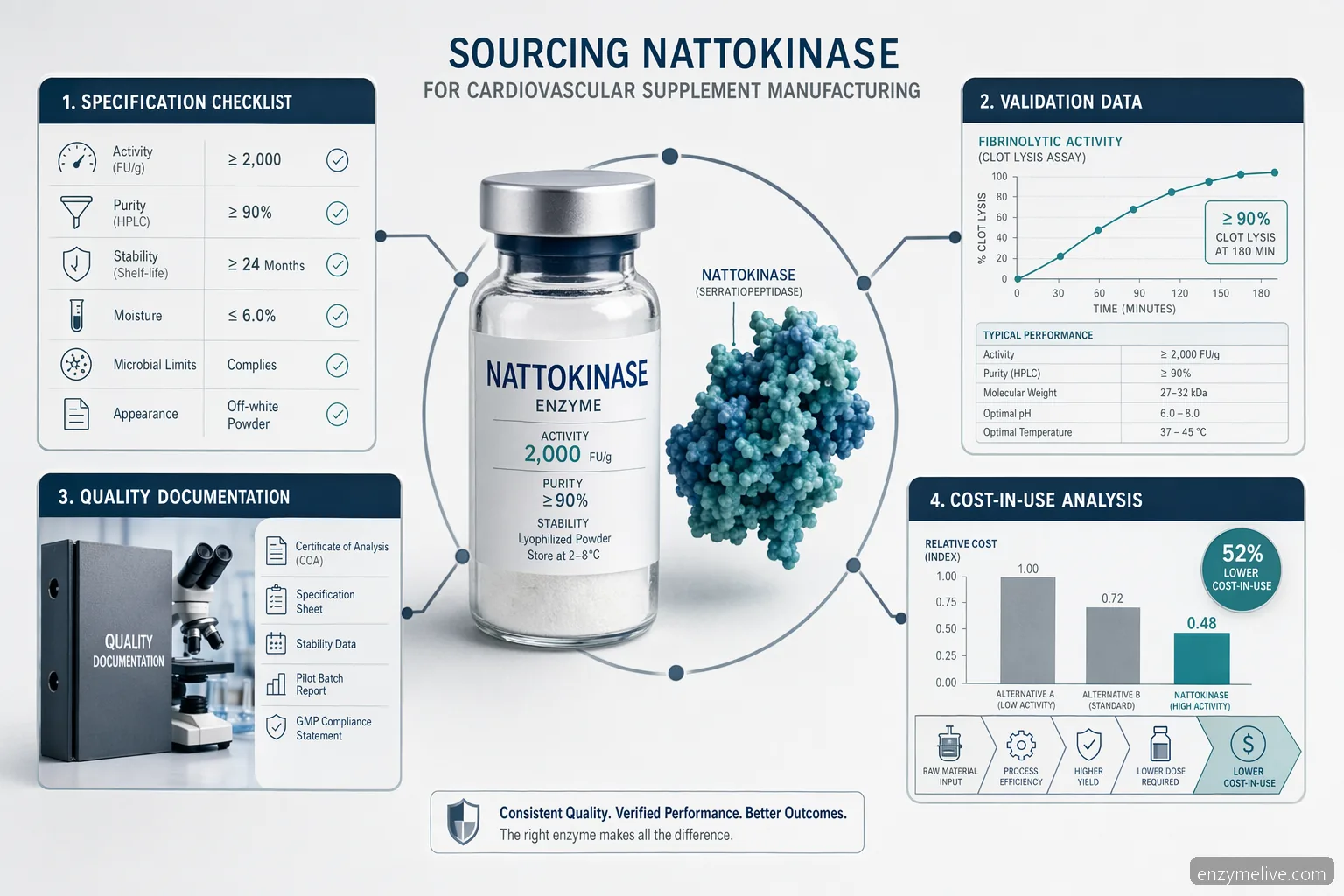
For industrial buyers asking “nattokinase where to buy,” the practical answer is: from suppliers that can prove activity, traceability, and manufacturing fitness for your dosage form. Nattokinase is a fibrinolytic enzyme typically produced by fermentation using Bacillus-derived processes, then purified, dried, standardized, and blended to a target activity. For cardiovascular supplements, compare suppliers on declared activity units, analytical method, lot-to-lot variability, microbiological control, carrier system, and stability profile. The term nattokinase supplement is consumer-facing, but procurement should focus on process compatibility and compliance documentation. If your market research includes terms such as nattokinase kaufen, nattokinase wirkung, or what is nattokinase, keep those claims separate from raw material qualification. Supplier selection should not depend on medical promises. Instead, evaluate whether the nattokinase enzyme can survive blending, encapsulation, compression, packaging, storage, and distribution while meeting your finished-product label target.
Prioritize verified activity per batch. • Confirm the analytical method used for standardization. • Check carrier, flowability, and particle size. • Assess traceability and change-control practices.
Core specification checklist for procurement
A complete nattokinase specification should define enzyme activity, appearance, odor, moisture, ash, bulk density, particle size, microbiology, heavy metals, residual solvents where relevant, and carrier or excipient identity. Activity is commonly purchased as fibrinolytic units or equivalent supplier-defined units, so procurement must verify the assay method and acceptance range. For dry supplement manufacturing, typical handling is ambient, low-humidity processing, with limited heat exposure. Avoid high-shear or prolonged compression studies without activity testing because enzymes can lose measurable function under stress. Formulation teams commonly evaluate dosage bands based on finished-product design, for example 50 mg to 200 mg nattokinase preparation per serving, depending on activity strength and regulatory positioning. This is a manufacturing planning range, not medical dosage guidance. Require COA, TDS, SDS, specification sheet, allergen statement, non-GMO or fermentation-origin statements only if supported, and batch-retained sample availability.
Define activity units and assay acceptance range. • Set microbiology and contaminant limits. • Confirm carrier and excipient declaration. • Request stability data under proposed packaging.
Process conditions and pilot validation
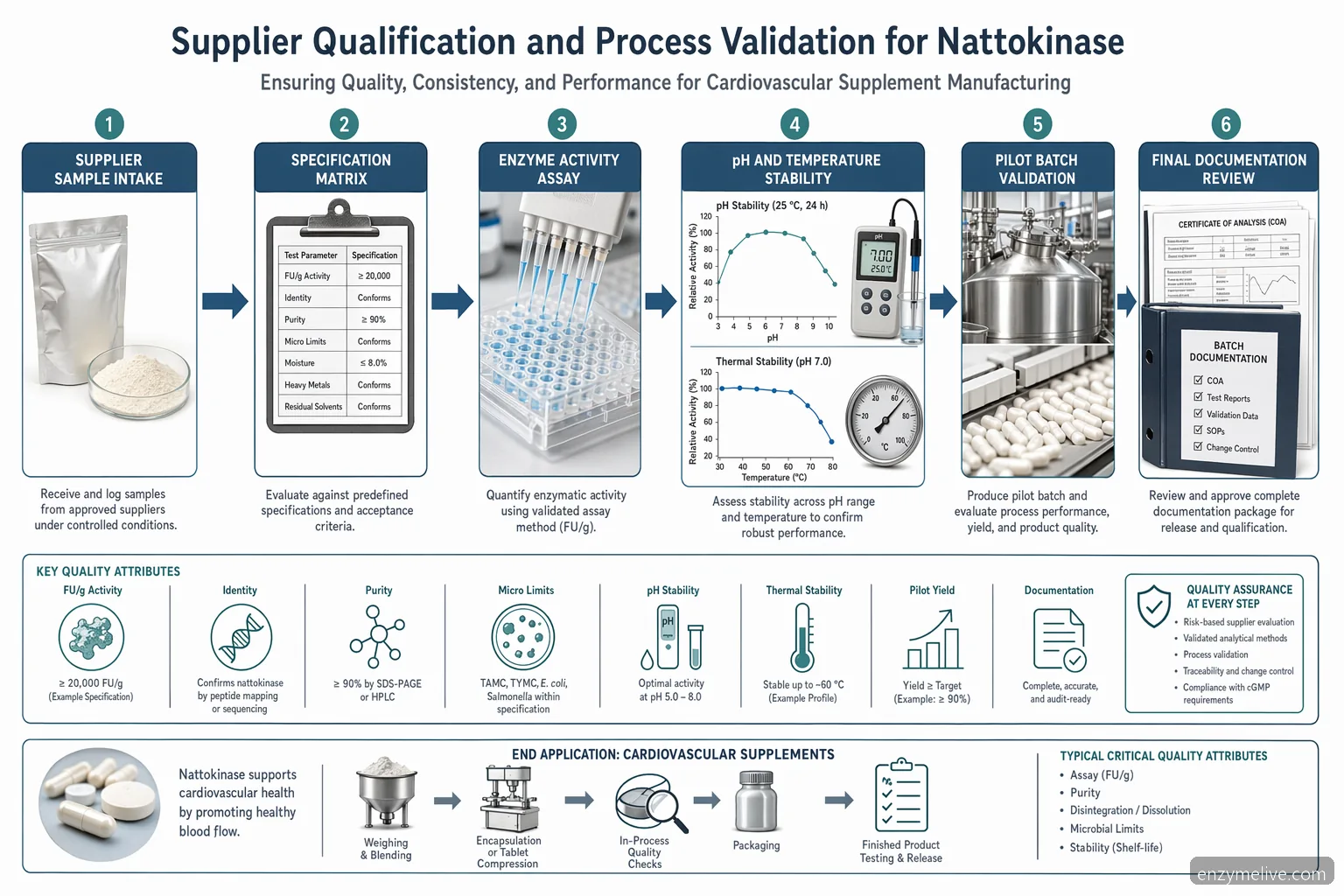
Pilot validation is essential before committing to a long-term nattokinase supplements program. Enzyme preparations are usually most stable in dry, controlled conditions; high humidity, aggressive heat, and prolonged mechanical stress may reduce activity. For development trials, maintain blending rooms around typical supplement conditions, often 18–25 °C with controlled relative humidity, and record actual exposure time. If aqueous processing is considered, check supplier data first; many proteolytic enzymes show activity in mildly neutral to alkaline ranges, often around pH 6.0–9.0, but finished supplement formats generally avoid extended water contact. Tablet compression should be validated by testing activity before and after compression at the chosen hardness. Capsule filling should include blend uniformity, capsule weight variation, and post-fill activity checks. Pilot batches should represent your real excipient system, packaging, desiccant use, and shipping temperatures to estimate cost-in-use accurately.
Test activity before and after processing. • Monitor temperature, humidity, and hold time. • Validate compression or encapsulation parameters. • Use the same packaging intended for scale-up.
Quality, safety documentation, and supplier qualification
Industrial buyers comparing nattokinase where to buy should treat documentation quality as part of the product. A supplier should provide a current COA for each lot, a TDS describing composition and use conditions, and an SDS covering safe handling. Additional qualification documents may include manufacturing flow summary, country of origin, fermentation organism statement, allergen declaration, contaminant test summary, shelf-life justification, and recall or change-control procedure. Search terms such as nattokinase dangers and nattokinase wirkung leber often reflect consumer safety questions, but B2B teams should translate them into labeling review, regulatory assessment, contraindication claim review, and adverse-event monitoring procedures handled by qualified professionals. Do not rely on unsupported health claims from raw material sellers. Instead, require transparent test methods, realistic specifications, batch traceability, and prompt notification of process, site, carrier, or assay changes that could affect finished-product compliance.
Require COA, TDS, and SDS before sampling. • Review contaminant and microbiology testing. • Document supplier change-control expectations. • Separate raw material specs from consumer claims.
Cost-in-use and commercial sourcing strategy
The lowest price per kilogram is rarely the lowest cost-in-use for nattokinase enzyme. A stronger, more consistent activity grade may reduce inclusion rate, improve capsule count economics, and lower excipient burden. Conversely, a cheaper low-activity preparation can increase fill weight, complicate uniformity, and raise testing costs. Compare suppliers by delivered activity cost, minimum order quantity, lead time, shelf life remaining at receipt, packaging size, customs documentation, and technical support. For multi-market products, ask whether the supplier can support separate documentation packages for different regulatory destinations without making prohibited claims. Include second-source planning early, but validate each source independently because assay methods and carriers can differ. A good sourcing decision balances specification certainty, pilot performance, supplier qualification, and commercial resilience. For buyers searching nattokinase kaufen or nattokinase where to buy, the best supplier is the one that keeps your production, QC, and compliance teams aligned.
Calculate cost per verified activity unit. • Include testing, yield loss, and rework risk. • Compare MOQ, lead time, and shelf life. • Qualify backup suppliers before shortages occur.
Technical Buying Checklist
Buyer Questions
Nattokinase is an enzyme preparation used by supplement manufacturers, commonly standardized by fibrinolytic activity. In B2B sourcing, the key issue is not consumer-facing nattokinase wirkung language, but whether the powder meets activity, purity, microbiology, stability, and documentation requirements. Buyers should evaluate the assay method, carrier system, batch consistency, and suitability for their specific capsule, tablet, or powder manufacturing process.
Manufacturers should buy nattokinase from qualified enzyme suppliers that provide complete technical and quality documentation, including COA, TDS, SDS, specifications, contaminant testing, and traceability. The preferred supplier should support pilot validation, disclose carrier materials, confirm activity testing methods, and respond to change-control requests. Price matters, but verified activity cost, lead time, shelf life, and batch consistency usually matter more.
Searches for nattokinase dangers usually relate to consumer safety questions, contraindications, or label review. For B2B procurement, translate those concerns into documented quality checks, regulatory assessment, claim control, and finished-product risk review by qualified professionals. Raw material suppliers should not be selected based on unsupported health claims. Instead, require transparent specifications, contaminant testing, allergen information, and a reliable SDS for safe industrial handling.
Pilot production should test the actual blending, encapsulation, compression, packaging, and storage conditions intended for scale-up. Track temperature, humidity, hold time, compression force, and exposure to moisture. Typical dry-room development may occur around 18–25 °C with controlled humidity, but the supplier’s stability data should guide limits. Confirm enzyme activity before and after processing to quantify retention and cost-in-use.
Compare nattokinase ingredients by cost per verified activity unit, not only price per kilogram. Include inclusion rate, overage strategy, assay cost, blend performance, reject risk, shelf life, freight, MOQ, and supplier support. A higher-activity or more consistent material can reduce capsule fill weight and simplify formulation. Each source should be pilot validated because activity assays, carriers, and stability can vary between suppliers.
Nattokinase for Research & Industry
Need Nattokinase for your lab or production process?
ISO 9001 certified · Food-grade & research-grade · Ships to 80+ countries
Frequently Asked Questions
What is nattokinase from a B2B raw material perspective?
Nattokinase is an enzyme preparation used by supplement manufacturers, commonly standardized by fibrinolytic activity. In B2B sourcing, the key issue is not consumer-facing nattokinase wirkung language, but whether the powder meets activity, purity, microbiology, stability, and documentation requirements. Buyers should evaluate the assay method, carrier system, batch consistency, and suitability for their specific capsule, tablet, or powder manufacturing process.
Where should manufacturers buy nattokinase enzyme?
Manufacturers should buy nattokinase from qualified enzyme suppliers that provide complete technical and quality documentation, including COA, TDS, SDS, specifications, contaminant testing, and traceability. The preferred supplier should support pilot validation, disclose carrier materials, confirm activity testing methods, and respond to change-control requests. Price matters, but verified activity cost, lead time, shelf life, and batch consistency usually matter more.
How should nattokinase dangers be handled in supplier review?
Searches for nattokinase dangers usually relate to consumer safety questions, contraindications, or label review. For B2B procurement, translate those concerns into documented quality checks, regulatory assessment, claim control, and finished-product risk review by qualified professionals. Raw material suppliers should not be selected based on unsupported health claims. Instead, require transparent specifications, contaminant testing, allergen information, and a reliable SDS for safe industrial handling.
What process conditions should be tested during pilot production?
Pilot production should test the actual blending, encapsulation, compression, packaging, and storage conditions intended for scale-up. Track temperature, humidity, hold time, compression force, and exposure to moisture. Typical dry-room development may occur around 18–25 °C with controlled humidity, but the supplier’s stability data should guide limits. Confirm enzyme activity before and after processing to quantify retention and cost-in-use.
How do buyers compare nattokinase supplements ingredients by cost?
Compare nattokinase ingredients by cost per verified activity unit, not only price per kilogram. Include inclusion rate, overage strategy, assay cost, blend performance, reject risk, shelf life, freight, MOQ, and supplier support. A higher-activity or more consistent material can reduce capsule fill weight and simplify formulation. Each source should be pilot validated because activity assays, carriers, and stability can vary between suppliers.
Related: Best Nattokinase Benefits in Industrial & Supplement Processing
Turn This Guide Into a Supplier Brief Request nattokinase COA, TDS, SDS, and a pilot-scale sample for supplier qualification. See our application page for Best Nattokinase Benefits in Industrial & Supplement Processing at /applications/nattokinase-industrial-benefits/ for specs, MOQ, and a free 50 g sample.
Contact Us to Contribute